
Building Unique Characters
Through actions most people would never do


I’ve heard people say that every story has already been written, and while I don’t quite believe that to be true, I do believe that not every character has been written, and that unique and specific characters are a necessity to create fresh and resonant stories.
Characters race against the outside pressure of the small word count to reveal themselves to the reader, to themselves, to the antagonist that puts pressure on them to make a choice, to take an action, they wouldn’t otherwise take if it weren’t for this narrative. In short stories, characters are given many attempts to rise above themselves, to fail, and fail worse, before coming to their reckoning. Flash relies on fewer opportunities, less guidance for the main character and the reader, more depth created by figurative language, and just the right details rather than the accumulation of backfill and backstory.
For this essay, we’re going to start with one of Kathy Fish’s micros to give us a chance to study how she invites silence and pauses, and points the reader toward the white spaces between periods, how she does a lot of work with accumulating details and adds context one line at a time, often hiding some element of the characters’ relationship until the turning point of the story.
Kathy’s micros often don’t follow a typical story structure but create their own through what is said and left unsaid. Some of her micros remind me a lot of Carver’s early work. The characters, when they talk to each other, often misunderstand, miss the moment, or can’t see the other character’s true selves in the scene.
For this, we’ll look at the micro, “Akimbo.”
Kathy has a way of starting her stories with just a bit of weirdness to make her characters and their lives unique!
We’re painting the nursery in the nude. Slapping eggshell over walls the color of a baby’s tongue. We’ve been at it awhile.
It’s a specific kind of character that would do this. It’s abnormal for most of us, so that sets the tone that these characters are a bit weird, and that makes them interesting! And we have a narrator who thinks a bit abnormally, too, in the way they mention the color being like the baby’s tongue. How you filter your details through your narrator creates tone and mood, and it also reveals some of the character to us!
The pink keeps bleeding through. We’re not using drop cloths because the carpet’s getting ripped up anyway—this sort of sculpted wall-to-wall that reminds me of my grandmother’s house and smells like cigarettes and corn. So we’re manic about it, spattering ourselves, our glasses, our hair and forearms, our privates.
This narrator is our guide through this story, through this scene that stands in for their entire relationship. This adds more weight when the scene is all we will get of these characters’ lives! We see that they’re not very good at painting, don’t care about making a mess, and are free spirits, but the house they are remodeling is also old, reminding her of her grandmother’s house.
You paint a heart on your chest. I smear a swath across my forehead. A Flock of Seagulls song plays on the radio. There’s a tremor and it makes us stop. Now a jolt and you go, Whoa Nellie. The windowglass trembles. Bits of plaster copter to the floor. Paint sloshes out of the can.
Small, but telling actions here in their playfulness. But Kathy gives us an escalation, a turn in the scene with the tremor. It gives the characters something else to make decisions about, to act or react. Notices how specific the details are with the paint and where it goes on their bodies, with the specific song, with the short burst of his dialogue!
You’re trying to reach me and all I can think of is the electric football game me and my brothers had when we were kids and how we’d work forever setting up our offensive and defensive lines and when we’d finally flip the switch, all the little plastic players just stood in one place and vibrated impotently.
I love how smoothly she enters into the backstory/memory here, how we often think in memory, how even a micro has room for a memory if it adds to the context or the pressure of the conflict/scene on the main character! And look at that great use of the adverb “impotently” and how it acts as a metaphor for the narrator’s feelings about the husband/boyfriend, how it’s all manic games until nature intrudes upon them, and she sees this man in a different light! Kathy has a real gift for using nature as an escalator, or a way of forcing her characters to see themselves or others in a new way that really cracks open the story!
This is you now, beautiful and vibrating, your arms akimbo, looking like all you want is to break free, achieve forward momentum, catch me, before the world splits apart.
And then this memory is ascribed to him, and she is hopeful that even though nature has intruded upon them, he might still be willing to catch her, to protect her! This is what I mean about Fish waiting until the end of the story or the three-quarters mark, to bring in the turn, the context or memory that reshapes the entire narrative!
Prompt: Start your story with two characters doing something a bit weird, a bit abnormal. Let them be excited or manic about it, let them take actions most people would never do. Put them in a setting that allows this wildness, that allows them to destroy even as they create. Find a way to let nature or the world intrude on them. Let this intrusion shine a new light on the protagonist! Use specific details such as smell or a song. Use a memory to provide context and allow the main character to see the antagonist in a new light. Limit yourself to very few lines of dialogue. Let us see the world clearly through the perspective of the main character!
Flash Sale on Spring Classes!
$25 per class if you buy at least 3 out of the 5! Ends on 3/15/26. (This also applies to anyone who has already paid for a class or classes.)
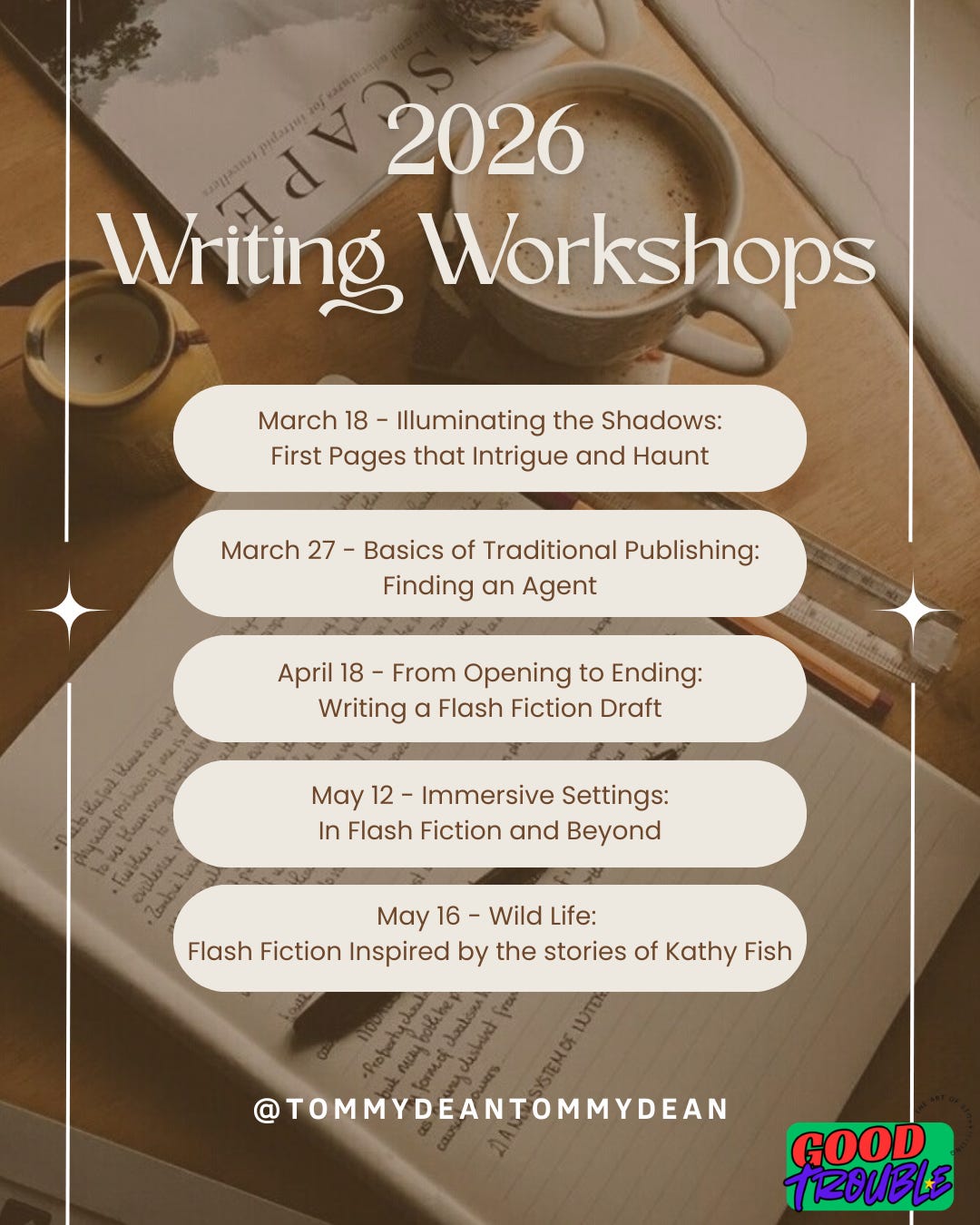


Have you checked out my editing services? I’ve added some discounts to help writers start the new year with agent-ready queries and novel openings!
I’d love to know more about what paid subscribers would like to get from paying for my Substack! Would you be interested in monthly office hours? A Free class? More access to my rough drafts? What do you get from other Substacks that you’d like to receive from me?